

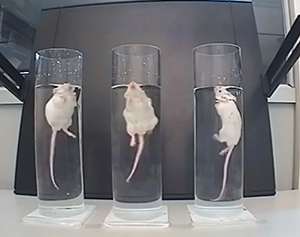
Say No! to Forced Swim Tests in Switzerland

Say No! to Forced Swim Tests in Switzerland

Imagine a rat or mouse trapped in a cylindrical, water-filled container. The walls are smooth; there is no way out. For several minutes, the animal swims around frantically and panicking until it gives up, expending only the bare minimum of energy to keep its head above water. Finally, the person conducting the experiment removes the animal from the container. The experiment is over. The rat (or mouse) is later killed.

The IAVS & LSCV demands a ban on the forced swim test in Switzerland! Please sign and share this petition with your friends and family!

Accelerating Humane and Human-Relevant Science

Accelerating Humane and Human-Relevant Science

The ethical and scientific crossroads

Millions of animals suffer in laboratories across Europe and globally each year, including dogs, cats, monkeys, and rodents (1). This practice is undergoing a significant re-evaluation due to ethical concerns and scientific limitations. Animal experimentation, long a staple of biomedical research and regulatory testing, is increasingly challenged by evidence of its poor applicability to human health.

A paradigm shift is underway, driven by scientific innovation, ethical pressure, and policy reforms, moving towards animal-free research methodologies (2). These Non-Animal Methodologies (NAMs) aim not just to reduce animal suffering but to provide scientifically superior tools. The language is evolving from "alternatives" to "replacements" and "superior methods," reflecting growing confidence in human-based approaches (3). Advanced technologies like artificial intelligence (AI), organoids, and organs-on-a-chip, coupled with public demand for ethical science (e.g., European Citizens' Initiatives (4)), are accelerating this transition. This article explores the failings of animal experimentation, the potential of NAMs, global policy shifts in the EU and US, and the next steps towards animal-free science.