

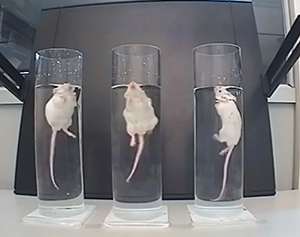
How does the test work?
Imagine a rat or mouse trapped in a cylindrical, water-filled container. The walls are smooth; there is no way out. For several minutes, the animal swims around frantically and panicking until it gives up, expending only the bare minimum of energy to keep its head above water. Finally, the person conducting the experiment removes the animal from the container. The experiment is over. The rat (or mouse) is later killed.
A cruel and controversial experiment
The goal of the so-called forced swim test (FST) is to measure the animal's desperation or perseverance and to draw conclusions for the development of antidepressants. In brain research, the test (also called the Porsolt test) serves to measure the animal's persistence and assess its psychological state. Insofar as the test involves simulated drowning, it is reminiscent of waterboarding, a well-known torture method. Under Swiss law, it is classified as severity level 3 – the highest possible level for stress and strain on laboratory animals. Overall, the scientific benefit of the results is completely disproportionate to this blatant cruelty.
An appeal to the universities that use this test
The LSCV contacted Swiss universities and colleges to get an overview of the status of the FST in Switzerland. Currently, the test is being administered at the Universities of Lausanne and Zurich, as well as at EPFL. However, this does not mean that it cannot be used again at other institutions in the future. For example, it was still being used in Fribourg and at ETH Zurich until recently.